Wind and Solar Outpace Fossil Fuels in Germany for the First Time in 2025
For the first time, Europe's largest economy generated more electricity from wind and solar (225 TWh, 44%) than from fossil fuels (217 TWh, 43%), according to Fraunhofer ISE and Ember.
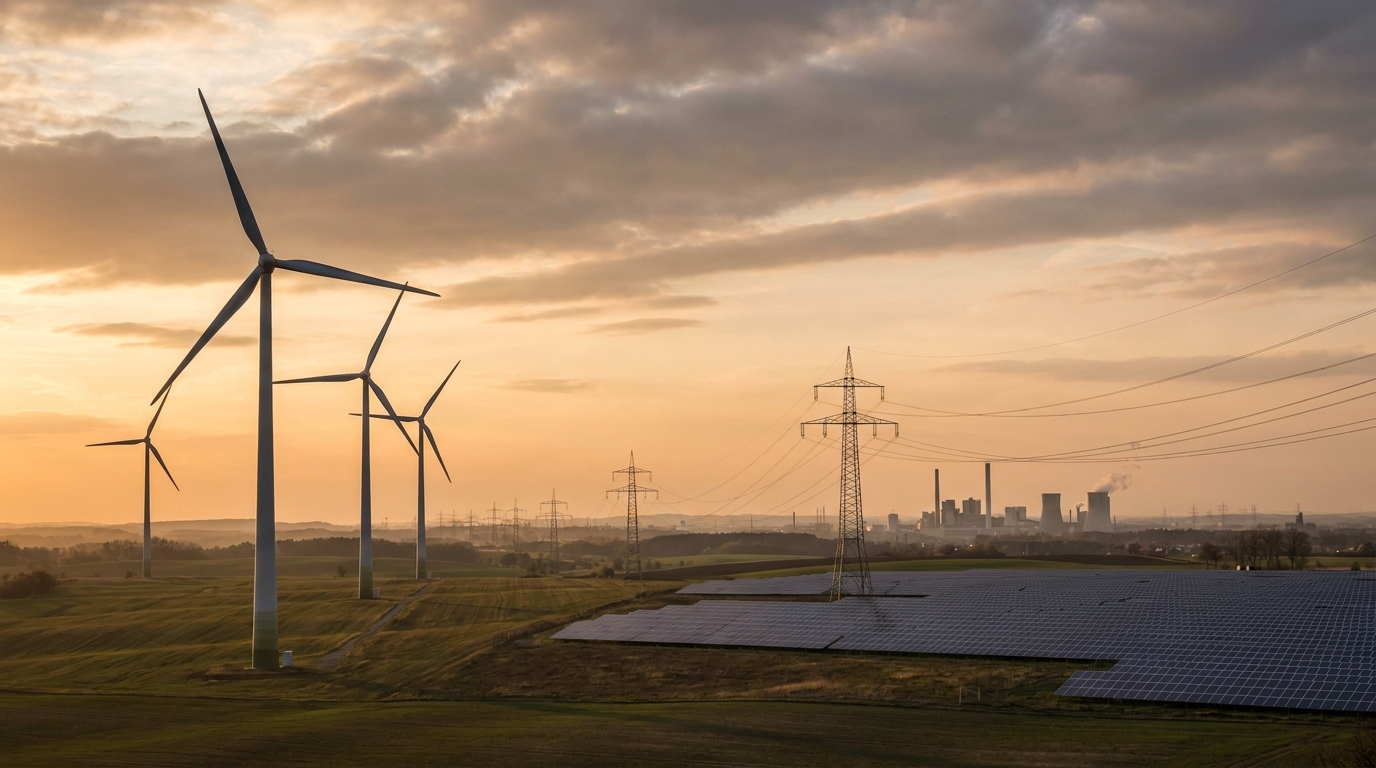
Wind and solar sources generated 225 terawatt-hours (TWh) in Germany during 2025, accounting for 44% of total electricity output and surpassing fossil fuels for the first time. Fossil fuels totaled 217 TWh (43%), according to data from Fraunhofer ISE and Ember analyzed by Carbon Brief on July 28.
This marks the first time Europe's largest industrial economy has crossed this threshold. The combined wind and solar penetration rate in Germany (45% according to Ember) comfortably doubles the European Union's 2025 average, where these technologies accounted for just 30% of electricity generation. The milestone was achieved without nuclear power (Germany's last nuclear plant closed in 2023) and despite onshore wind expansion continuing to lag behind its own targets: the country approved a record 20.8 gigawatts (GW) in new onshore wind permits during 2025, but total installed capacity of 68.1 GW fell short of the 76.5 GW target.
Solar photovoltaic was the engine behind the historic crossover. It generated 87 TWh, a 21% increase over 2024, and surpassed lignite (brown coal) individually for the first time, as lignite fell to 67.2 TWh, its lowest level since 1961. Wind contributed 132 TWh (106 TWh onshore and 26 TWh offshore). On the fossil side, natural gas supplied 52.4 TWh to the public grid and hard coal 26.7 TWh, the latter at levels comparable to 1952. Carbon dioxide (CO₂) emissions from Germany's electricity sector stood at 160 million tonnes, a 58% reduction from the start of the series in 1990, according to Fraunhofer ISE.
The German case offers a benchmark of technical feasibility for other industrial economies. With wind and solar penetration 15 percentage points above the EU average, achieved without nuclear power and with room to improve on wind expansion, Germany's trajectory defines what is achievable in markets where fossil generation still dominates the energy mix. The German government maintains its target of 80% renewable electricity by 2030 and a near-carbon-neutral electricity system by 2035.
This article was drafted with artificial intelligence assistance from verified sources and reviewed by a human editor before publication.
Sources
Related stories
This article was drafted with AI assistance from verified sources and reviewed by a human editor before publication.
← All news