Minnesota Opens Iron Mine for Green Steel; India Anchors Its Steel Industry to Coal
Minnesota opens its first iron mine in 50 years for green steel production. IEEFA warns: India anchors 64% of its steelmaking expansion to metallurgical coal.
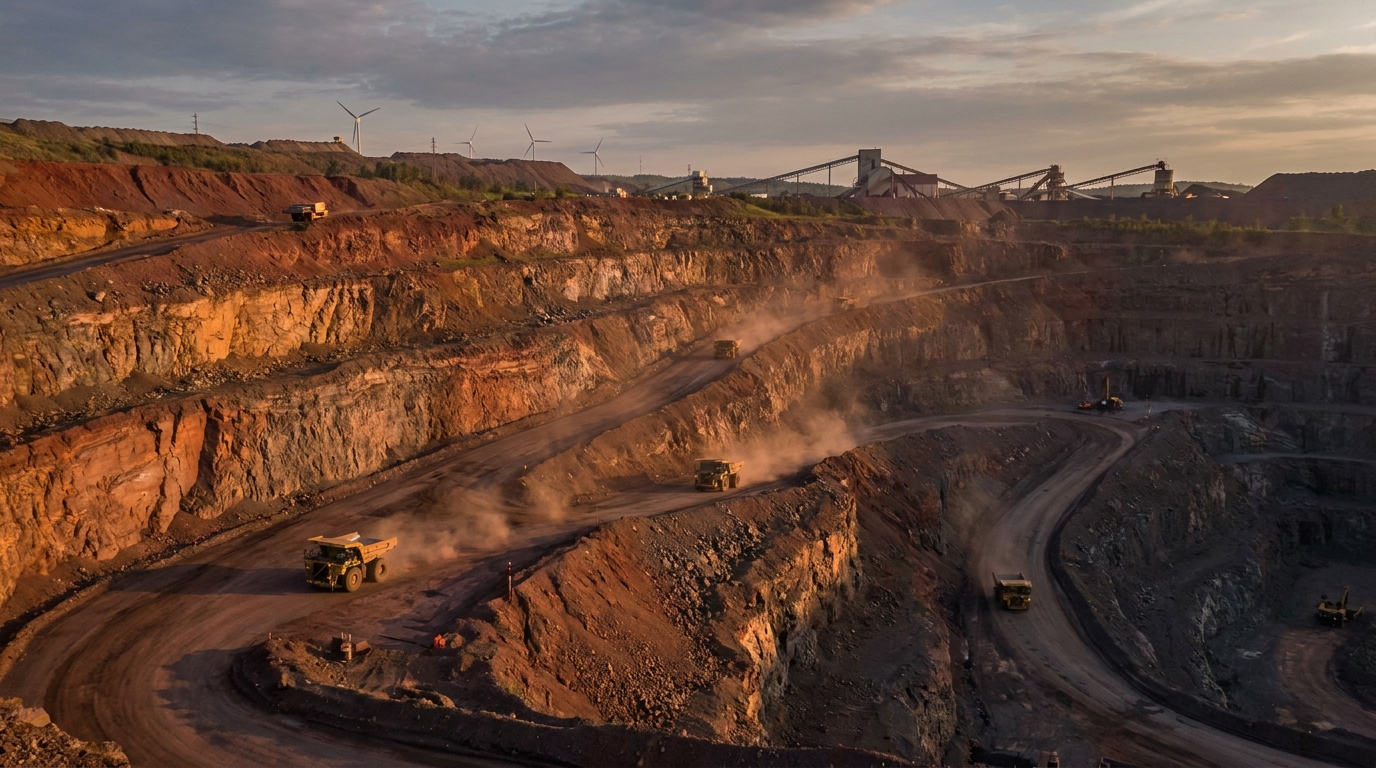
Mesabi Metallics, a subsidiary of Indian conglomerate Essar, conducted the first blast at its iron mine in Nashwauk, Minnesota on July 13, 2026, the first new mine in the state in 50 years. With a $2.5 billion investment, the project will produce 7 million tonnes per year of direct-reduction (DR) grade pellets with 68% iron purity to supply the decarbonized steel supply chain in the United States.
While Minnesota's Mesabi Range repositions toward green steel, the global steel industry is advancing at two speeds. An analysis from the Institute for Energy Economics and Financial Analysis (IEEFA), published on July 22, documents that India, the world's second-largest steel producer, keeps 64% of its 382 million tonnes (Mt) of steelmaking capacity under development anchored in blast furnaces running on metallurgical coal. India's imports of this input would reach 149 Mt by 2035, nearly double the current 94 Mt, according to S&P Global projections cited by IEEFA. India imports approximately 90% of the metallurgical coal it consumes.
The contrast between these two routes is both technical and commercial. The direct-reduction (DR) route using natural gas and an electric arc furnace (EAF) emits approximately 1.4 tonnes of CO2 per tonne of steel, 40% less than the 2.2 tonnes from a conventional blast furnace, according to data compiled by Canary Media. With green hydrogen as a reducing agent, emissions can approach zero. Mesabi Metallics is also evaluating a direct-reduced iron (DRI) plant in Kentucky and has applied for up to $10 billion in US EXIM financing for international sales. IEEFA warns that the leading metallurgical coal exporters (Australia, the United States, and Russia) project flat or declining volumes toward 2035. Australia forecasts a drop in its exports to 157 Mt by 2031, while S&P Global estimates 143 Mt for that same year.
Mesabi Metallics' first pellet production is scheduled for autumn 2026. Steel is a critical input for global energy infrastructure: wind towers, transmission lines, and battery structures all depend on this material. The gap between Minnesota's green corridor and India's coal-driven inertia illustrates that industrial decarbonization is not advancing at a single speed, and that access to high-purity ore and financing defines which markets lead the transition.
This article was produced with artificial intelligence assistance from verified sources and reviewed by a human editor before publication.
Sources
Related stories
This article was drafted with AI assistance from verified sources and reviewed by a human editor before publication.