IEEFA: AI Forecasts Quintuple Actual Gas Demand in the U.S. Southeast
The energy think tank has filed objections before FERC against two pipelines totaling $5.2 billion whose viability depends on data center demand projections far above historical consumption.
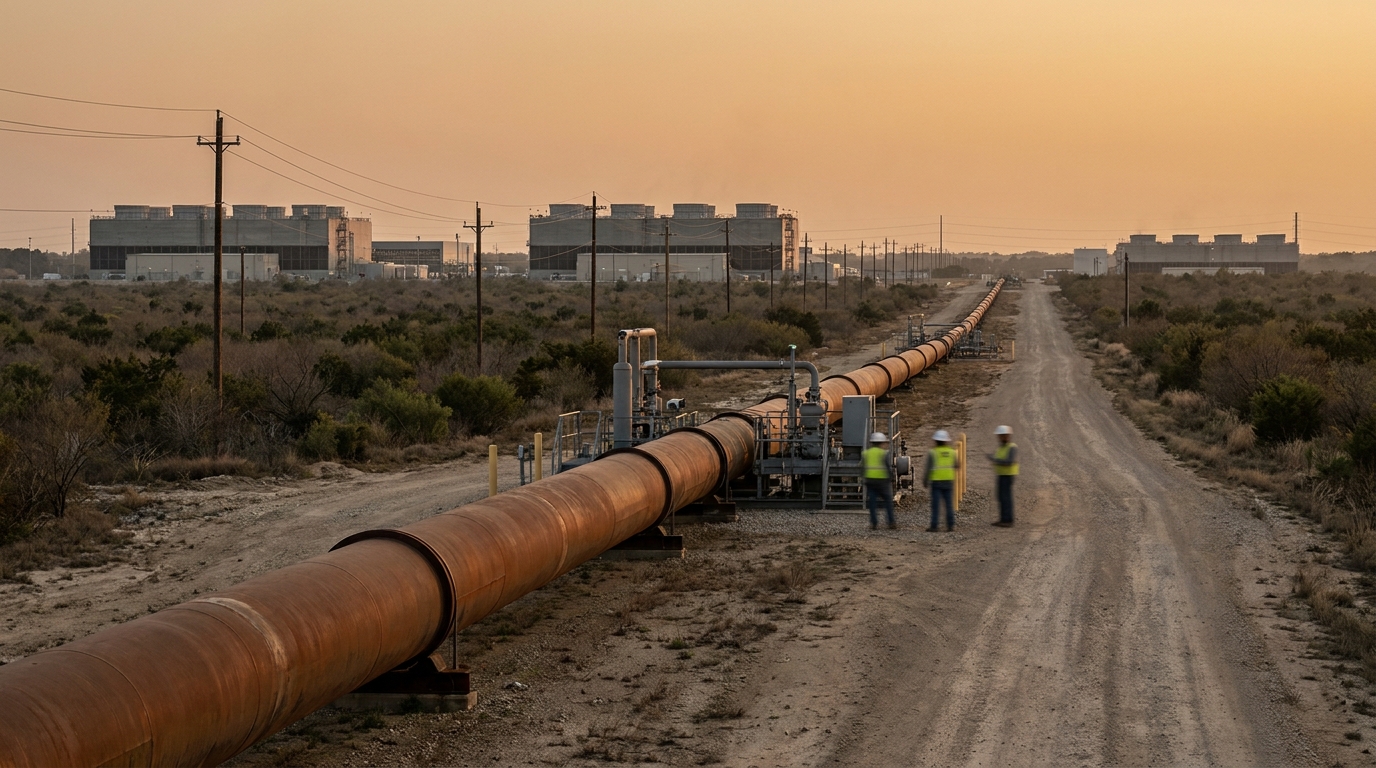
The natural gas demand projections used to justify two new pipelines in the U.S. Southeast are five times the region's actual historical consumption growth. The Institute for Energy Economics and Financial Analysis (IEEFA) presented its findings before the Federal Energy Regulatory Commission (FERC) on June 25: the two projects total $5.2 billion and their viability hinges on artificial intelligence data center forecasts that the pipeline operator itself acknowledges as an extreme scenario.
The two pipelines are Mississippi Crossing (MSX), operated by Kinder Morgan, a 199-mile project with capacity of 2.1 billion cubic feet per day (bcf/d) at a cost of $1.7 billion, and South System Expansion 4 (SSE4), operated by Southern Natural Gas, a 1.3 bcf/d expansion priced at $3.5 billion. Both have been contracted more than 90% by Southeastern utilities. The problem, according to IEEFA, is that gas demand in the region has been declining for eight years at an annual rate of 0.78%. In Kinder Morgan's own base scenario, maximum unmet demand reaches only 0.46 bcf/d, less than 15% of the proposed new capacity. The extreme scenario cited in the FERC filings, by contrast, projects 2.45 bcf/d.
The distortion extends beyond gas. Latitude Media reported on June 25 how the concentration of data centers in Northern Virginia has stalled the Mid-Atlantic Resiliency Link (MARL) transmission project, a 107-mile, $960 million line approved by grid operator PJM Interconnection in 2022. Four states (Maryland, Virginia, Pennsylvania, and West Virginia) are disputing who pays the bill. The trigger: data center load projections surged after the launch of ChatGPT and broke the historical regional cost-allocation model. The debate carries direct relevance for Mexico, where nearshoring is drawing data center investment to the country's north, a region with transmission constraints already documented in the National Electric System (SEN).
FERC is evaluating whether the two pipelines meet the public convenience and necessity standard required by federal law. IEEFA warns that captive consumers bear all the financial risk if projected demand fails to materialize. The FERC decision and the outcome of the MARL case will determine whether regional energy planning is anchored in verifiable data or speculative forecasts.
This article was drafted with artificial intelligence assistance from verified sources and reviewed by a human editor before publication.
Sources
Related stories
This article was drafted with AI assistance from verified sources and reviewed by a human editor before publication.
← All news