Chile Projects 27 to 58 GW of New Solar Capacity by 2057
Chile's Ministry of Energy has published the PELP 2028-2032 report projecting between 27 and 58 GW of new solar capacity by 2057. Transmission infrastructure sets the pace.
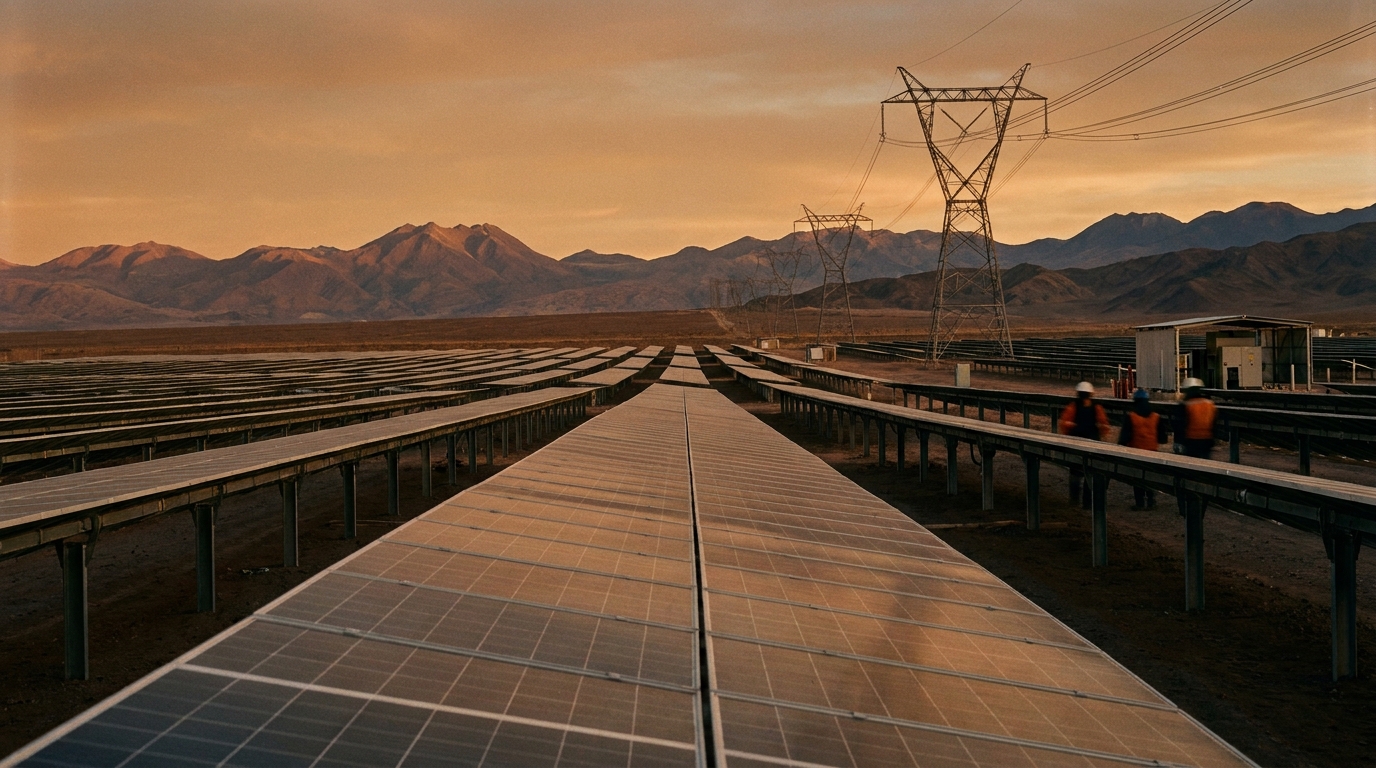
Chile's Ministry of Energy published the Preliminary Report of the Long-Term Energy Planning (PELP) 2028-2032 on July 24, projecting between 27 and 58 gigawatts (GW) of new photovoltaic solar capacity over the next 30 years. The range spans five scenarios combining different trajectories for economic growth, fuel costs, and technological evolution.
The PELP is Chile's primary electricity sector planning instrument, reviewed every five years with a minimum horizon of three decades. The model's baseline is 12,015 megawatts (MW) of existing solar capacity (comprising large-scale plants and distributed generation, PMGD) plus 490 MW under net-billing schemes. According to the report, solar and wind energy combined reach at least 83% of annual electricity generation by the end of the period, according to pv magazine Latam.
The Ministry itself identifies transmission as the primary limiting factor. The 500 kV Charrúa-Ancoa-Alto Jahuel-Lo Aguirre corridor requires an expansion of at least 1,750 megavolt-amperes (MVA) to carry wind generation from the central-south toward consumption centers and northward via the future Kimal-Lo Aguirre line. On 220 kV networks, some lines need to multiply their current capacity up to sixfold, with the greatest demands concentrated in the Antofagasta and Maule regions. In parallel, onshore wind expansion is projected at between 16 and 27 GW, while battery storage (BESS), which by end-2026 totals 4,078 MW installed or under construction with an average duration of 4.3 hours, accounts for a substantial share of new dispatch in 6- and 8-hour systems. The model does not incorporate pumped hydro expansion or thermal storage. Offshore wind appears in three of the five scenarios, with the earliest entry in 2041. National electricity demand grows between 4.1% and 47.8% over three decades, driven by electric mobility and data centers, whose projected capacity rises from 198 MW in 2024 to approximately 900 MW in 2057. Renewable curtailment is estimated at between 9% and 12% of generation.
The preliminary report will be open for public consultation until August 24, 2026. The final version will set the transmission investment signals that determine how much of Chile's solar potential materializes over the next three decades.
This article was drafted with artificial intelligence assistance from verified sources and reviewed by a human editor before publication.
Sources
Related stories
This article was drafted with AI assistance from verified sources and reviewed by a human editor before publication.
← All news