USMCA Review Opens with Energy Sector as Core Negotiating Issue
Mexico's 2025 energy reform and its private-sector participation rules are the principal friction point in the review of the trilateral trade agreement.
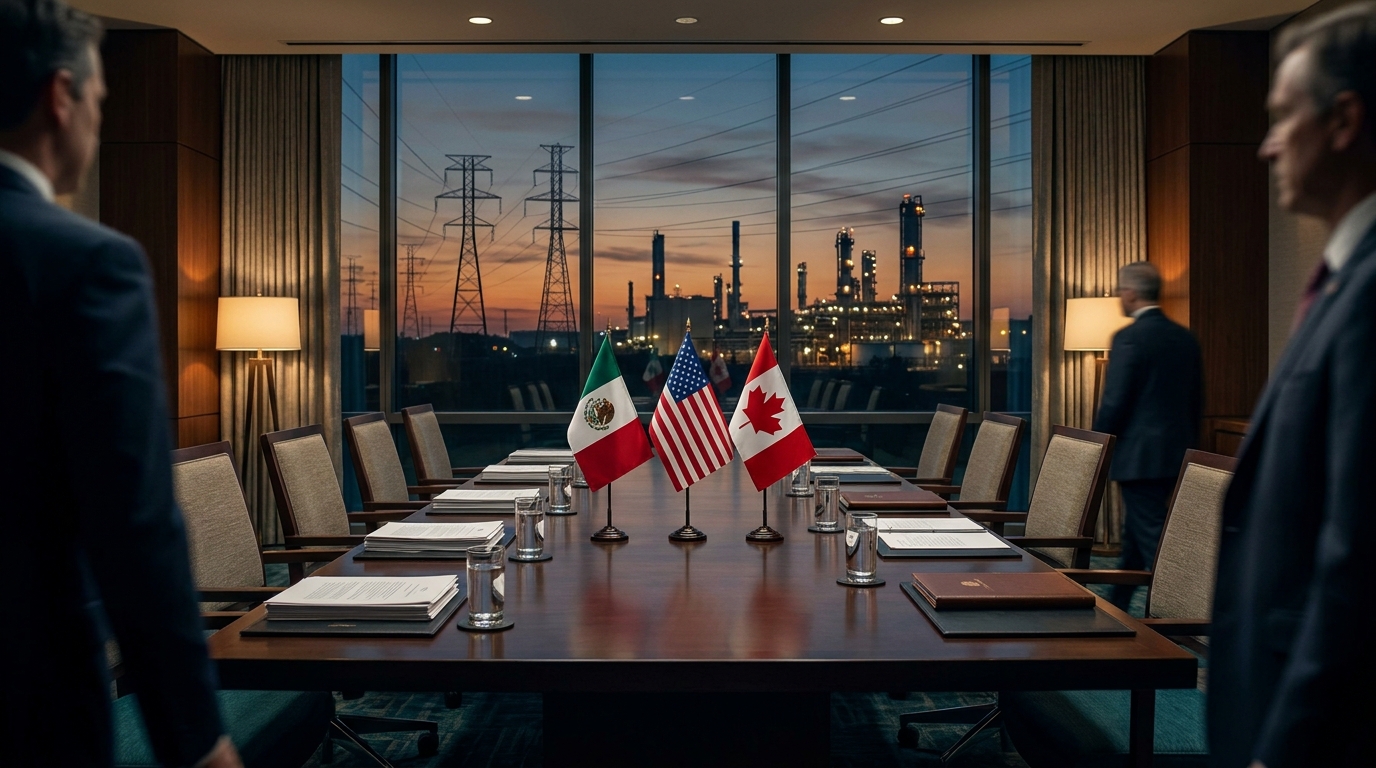
The formal review of the United States-Mexico-Canada Agreement (USMCA) opened on July 1, 2026, with the energy sector as the primary point of tension among the three trading partners. In the inaugural virtual meeting, Economy Secretary Marcelo Ebrard presented 13 negotiating items; Washington put forward 14, according to Bloomberg Línea.
The review clause in Article 34.7 of USMCA requires all three countries to assess the agreement on its sixth anniversary and decide whether to extend it for an additional 16 years, through 2042. Mexico and Canada have already sent letters confirming their intention to renew it, but the United States has not. Ebrard outlined two scenarios: a 16-year extension, or a 10-year term with annual reviews of defined issues if no consensus is reached. The outcome will set the investment rules for a regional energy market that moves cross-border flows of natural gas, electricity, and capital worth billions of dollars annually. The third round of bilateral negotiations is scheduled for July 20 in Mexico City.
The primary friction point is Mexico's energy regulatory framework. The 2025 constitutional reform requires the Federal Electricity Commission (CFE) to generate at least 54 percent of the national electricity supply and to hold a minimum 54 percent stake in all private generation projects, with priority dispatch on the grid. The United States and Canada contend that these provisions violate the USMCA's market access, investment, and state-owned enterprise chapters, which require competitive neutrality.
The uncertainty is already affecting investment decisions. Banamex, cited by El Universal, projects that annual reviews will extend through 2028 and warns that gross fixed capital formation fell 6.3 percent in 2025. The bank maintains its GDP growth forecast of 1.3 percent for 2026 and 1.8 percent for 2027.
The energy negotiations will determine the regulatory certainty for renewable energy, storage, and transmission investment projects in Mexico over the next decade. The third bilateral round on July 20 in Mexico City will be the first concrete test of both sides' room to maneuver on the agreement's most sensitive chapter.
This article was drafted with artificial intelligence assistance from verified sources and reviewed by a human editor before publication.
Sources
Related stories
This article was drafted with AI assistance from verified sources and reviewed by a human editor before publication.
← All news