Wind output rises 17% in the late afternoon as SENER projects 15,000 MW by 2030
Solar concentrates at midday while wind grows as the SEN enters its highest-demand window.
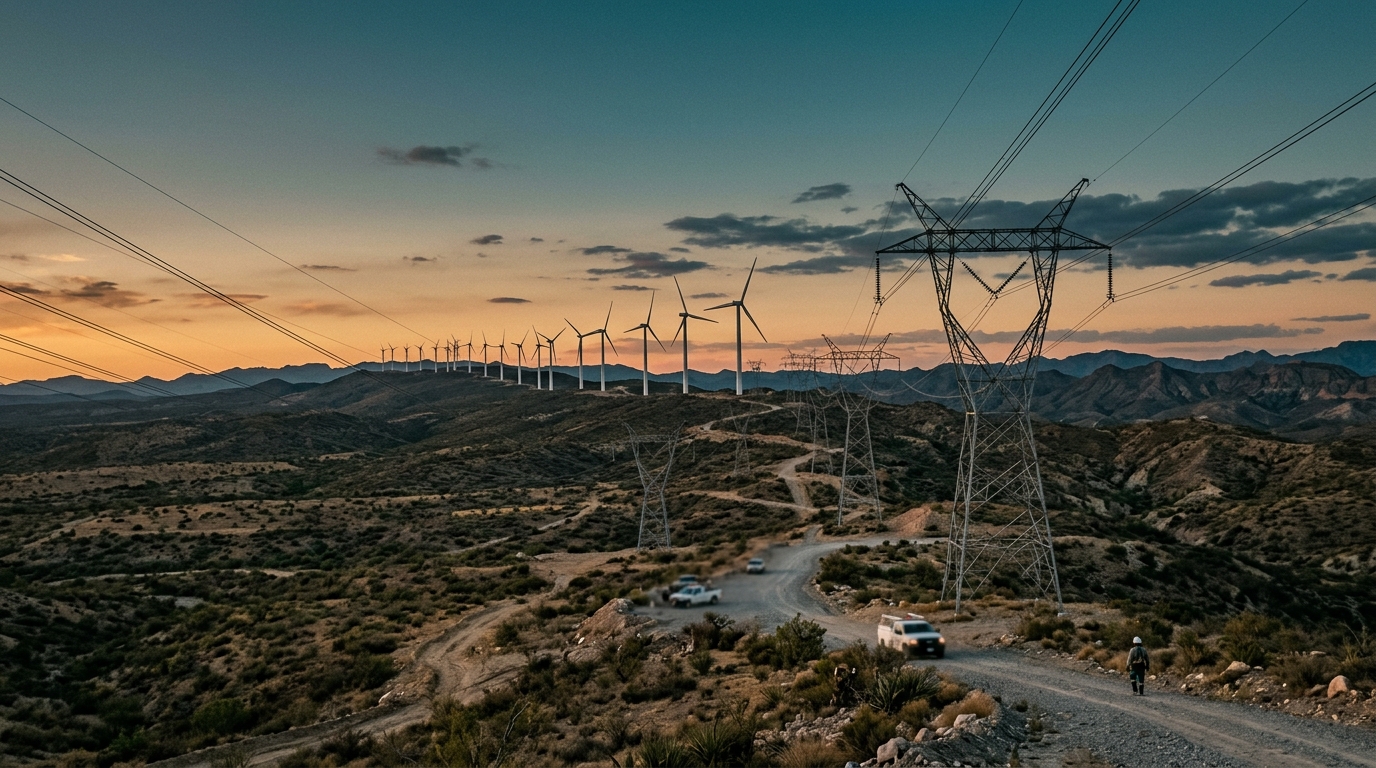
Wind generation in Mexico raises its output by around 17% between 15:00 and 19:00 hours, when the National Electric System (SEN) enters its highest-demand window, while solar photovoltaic concentrates its contribution at midday and cuts it back at dusk, according to a Vestas analysis released in August 2026.
That hourly differential arrives at a moment of expansion. The undersecretary for Energy Planning and Transition, Jorge Islas Samperio, presented at a forum of the Mexican Wind Energy Association (AMDEE) and the Global Wind Energy Council (GWEC) the official projection of 84% growth in wind capacity by 2030, to 15,000 MW, according to La Jornada and the EFE dispatch reproduced by Infobae. Of the 6,860 MW to be added, 4,701 MW are already assigned to 17 plants and 2,159 MW remain pending. The Ministry of Energy (SENER) estimates that the renewable share will move from 24.61% of generation (82 TWh) in 2025 to more than 38% (170 TWh) in 2030.
The Vestas study argues that grouping both technologies under the intermittency label hides operational differences: solar follows the sun's cycle and wind responds to wind patterns that intensify toward the afternoon. Mehdi Hadbi, country manager of Vestas Mexico, said that "the question is no longer only how much energy a technology can generate, but how well aligned it is with the real needs of the electric system." The document cites the cases of California and Brazil, where solar concentration produced the duck curve. SENER's call for Electric Energy Storage Systems (SAEE) establishes 935 MW of batteries with three hours of backup and criteria of operational flexibility, power contribution and relief of congestion on the National Transmission Grid.
The deadline to register expressions of interest in the storage call expires on October 30, 2026, after the third modification published in the Official Gazette of the Federation (DOF) on September 2. CFE reported eight wind projects totaling 2,949 MW under mixed schemes, with close to 890 MW of batteries, expected to operate between 2029 and 2030.
This article was written with the assistance of artificial intelligence from verified sources and reviewed by a human editor before publication.
Sources
- ¿Por qué la hora de generación eléctrica importa más que la cantidad?
- Sener proyecta un crecimiento de 84% en energía eólica para 2030
- México proyecta que su capacidad eólica crezca un 84 % hacia el 2030
- Acuerdo por el que se emite la Tercera Modificación a la Convocatoria para la Atención de Proyectos Estratégicos de Generación y Almacenamiento de Energía Eléctrica
Related stories
This article was drafted with AI assistance from verified sources and reviewed by a human editor before publication.