Fervo runs 33 MW of geothermal in Utah and the challenge moves to the wells
The first Cape Station block reaches commercial operation and shifts the sector's test to well performance and integrity.
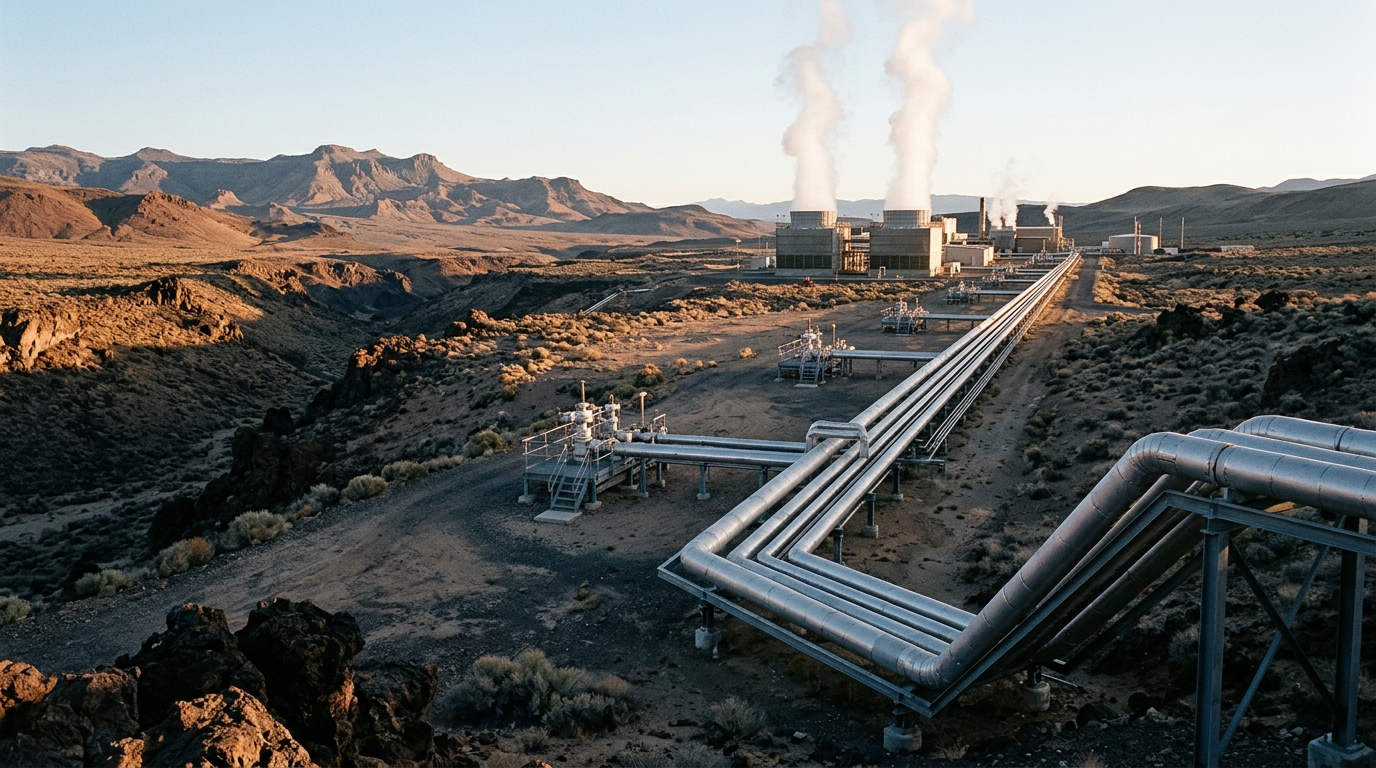
On September 30, 2026, Fervo Energy declared commercial operation of the first of its three 33 MW blocks at Cape Station, in Beaver County, Utah, the first enhanced geothermal (EGS) greenfield development to reach contractual commercial operation, as reported by Canary Media.
The project, at roughly $2 billion and 500 MW of final capacity, advances in phases: Phase I adds close to 100 MW across three 33 MW blocks, with the remaining two committed for January 1, 2027, and Phase II adds 400 MW under construction with a target date in 2028, according to Canary Media. Costs mark the scaling path: Phase 1 delivers electricity at about $7,000 per kW and Phase 2 at $5,500 per kW, against an average of $2,157 per kW at new natural gas plants in 2025. Geothermal contributes 0.4% of United States electricity generation.
Well performance defines that path. In a 30-day flow test at Cape Station, reported in 2024, the well reached a peak flow rate of 107 kg/s and the company estimated capacity for more than 10 MW, above the level the National Renewable Energy Laboratory (NREL) projected for 2035 and nearly triple its Project Red pilot, according to Utility Dive. For the industry, the bottleneck has moved to the life cycle. An analysis by Calum Watson, technical sales manager for geothermal at Expro, published by ThinkGeoEnergy and republished in Spanish by Piensa Geotermia, argues that performance depends on well integrity and on interventions, given subsurface conditions: high temperatures, aggressive fluids and scaling. Distributed fiber optic sensing (DFOS) quantifies injection distribution with accuracy close to 3% under dynamic thermal conditions, according to the same article.
The two remaining Phase I blocks have a contractual date of January 1, 2027, and Phase II, at 400 MW, targets 2028. The indicator to watch is sustained well performance, no longer drilling.
This note was drafted with the assistance of artificial intelligence from verified sources and reviewed by a human editor before publication.
Sources
- In global first, a next-gen geothermal plant goes live at utility scale
- Cape Station may be world's most productive geothermal system to date: Fervo
- Geothermal's next challenge isn't drilling, it's well performance
- El próximo desafío de la energía geotérmica no es la perforación, sino el rendimiento de los pozos
Related stories
This article was drafted with AI assistance from verified sources and reviewed by a human editor before publication.
← All news