CFE Operates 72 MW of Battery Storage in Puerto Peñasco, Accelerating Grid Response
CFE operates 72 MW of battery storage in Puerto Peñasco and is building an additional 174 MW. BESS systems reduce response times during demand spikes on Mexico's national electricity grid.
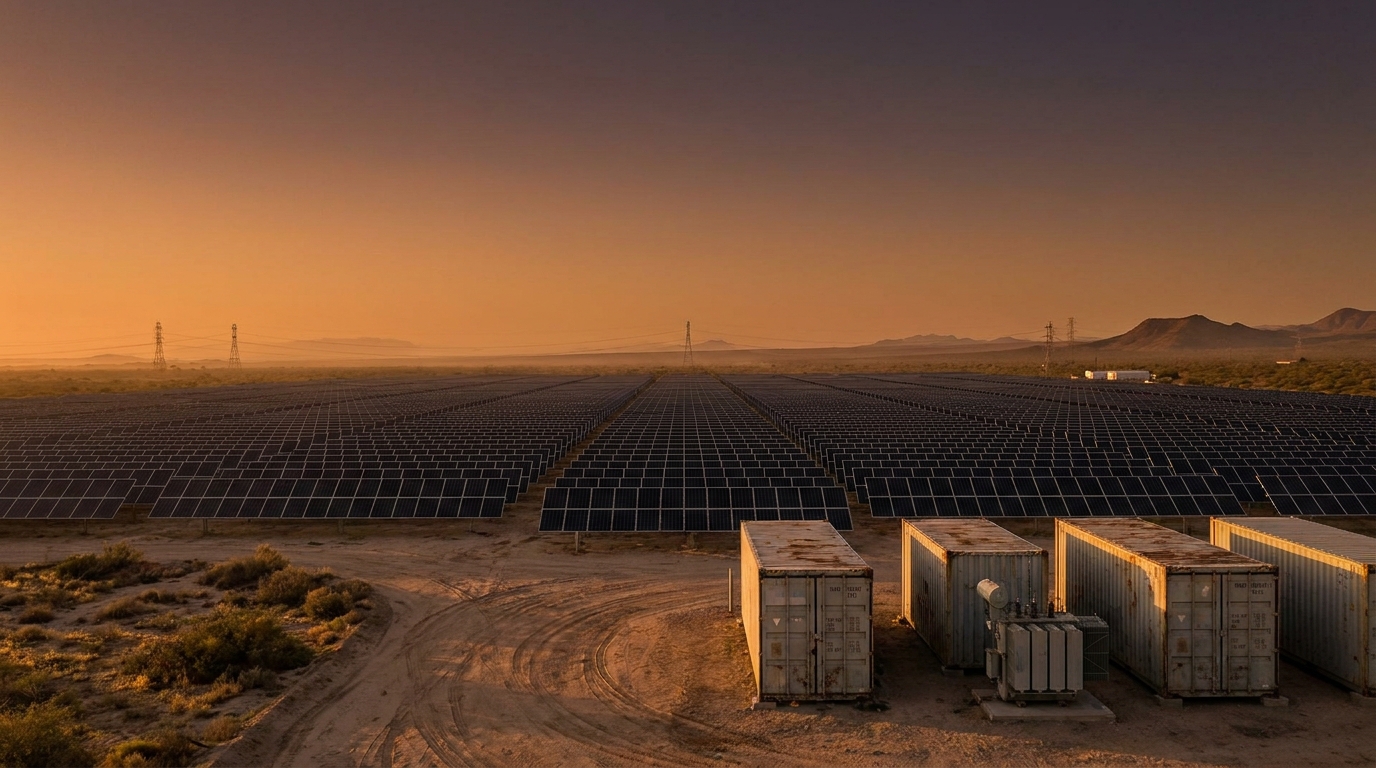
Mexico's Federal Electricity Commission (CFE) is operating 72 megawatts (MW) of utility-scale battery energy storage systems (BESS) at the Rafael Galván Maldonado Solar Power Plant in Puerto Peñasco, Sonora, and is constructing an additional 174 MW that will bring total storage capacity at the complex to 246 MW, the company announced on June 25.
The deployment is designed to reduce response times across the National Electric System (SEN) during sudden demand fluctuations, compounded by the extreme temperatures gripping the country, and forms part of CFE's broader strategy to integrate storage as a layer of operational reliability. President Claudia Sheinbaum stated on June 24 that recent supply interruptions stem from distribution infrastructure limitations, not from insufficient generation capacity, according to Forbes México.
CFE Director General Emilia Calleja Alor explained that BESS units store electricity during periods of high availability (primarily from solar and wind sources) and release it when demand rises or renewable generation falls. The technology functions as a strategic reserve that balances supply and demand in real time. CFE identified seven benefits of utility-scale storage, including greater operational reliability, more efficient integration of renewables, optimization of transmission lines and substations, and lower costs for ancillary services.
Beyond the Sonora complex (an investment exceeding $1.4 billion that will reach 1,000 MW of solar generation), CFE is developing the Sistema Oasis project in Mulegé, Baja California Sur. This project integrates a 72 MW solar plant with a 20 MW BESS capable of 2 to 3 hours of autonomy, and uses surplus energy to produce green hydrogen. According to Infobae México, the system will benefit 40,000 households and avoid 94,389 metric tons of CO₂ annually.
Phases III and IV of the Puerto Peñasco project, currently under construction, will add 174 MW of storage and extend coverage to nearly 56,000 additional people. The operational precedent set by this deployment will be decisive in enabling the Energy Regulatory Commission (CRE) to authorize new private-sector storage projects in the coming months.
This article was drafted with artificial intelligence assistance from verified sources and reviewed by a human editor before publication.
Sources
Related stories
This article was drafted with AI assistance from verified sources and reviewed by a human editor before publication.