Atlantic Council: Only a Corridor Network Protects Against Another Hormuz-Style Supply Crisis
The think tank proposes expanding the IMEC corridor with nodes in Oman, Saudi Arabia, Egypt, and Syria as a redundancy architecture against future disruptions from maritime chokepoints.
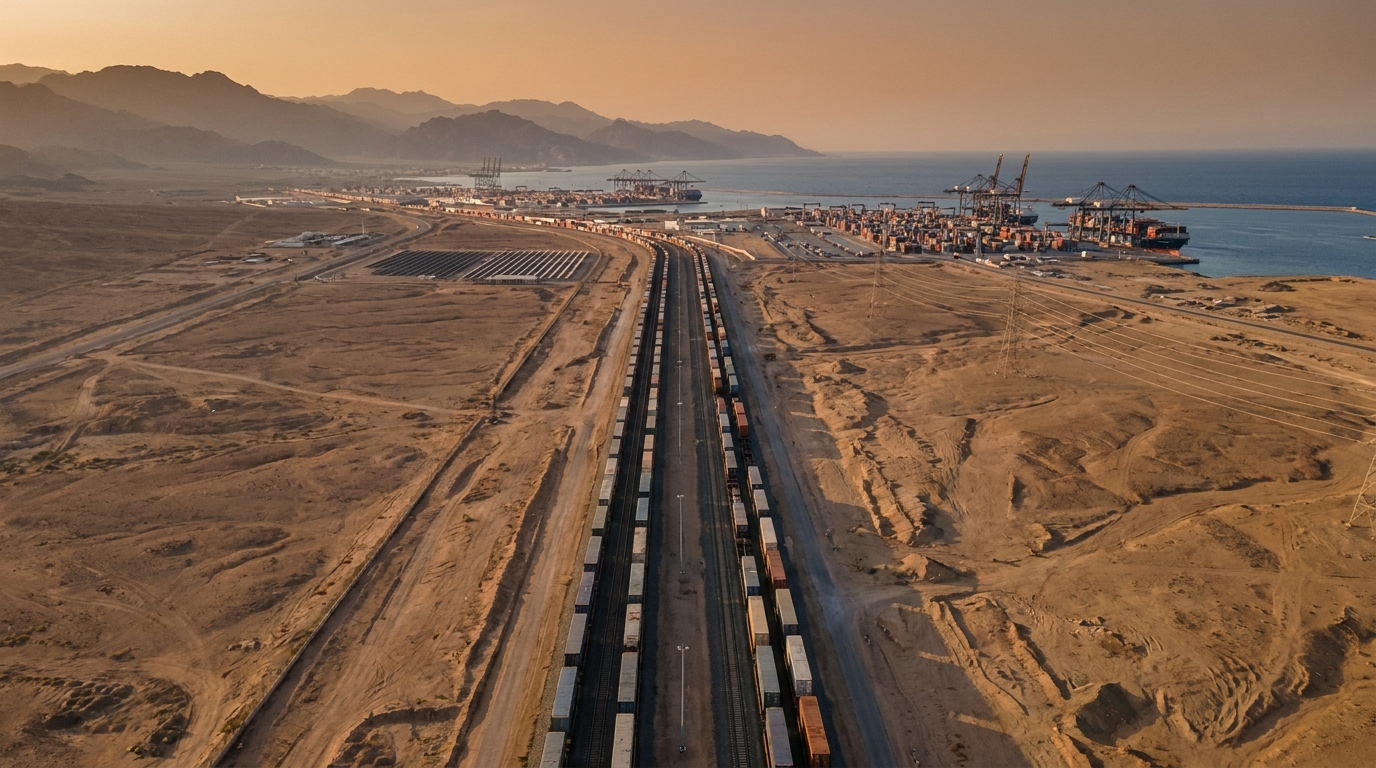
The closure of the Strait of Hormuz in February 2026 removed 11 million barrels per day from the global market, the largest oil supply disruption on record, according to Bloomberg. A report by the Atlantic Council Global Energy Center, published on June 30, concludes that only an interconnected network of land corridors provides structural protection against future blockades at maritime chokepoints.
The report, authored by Afaq Hussain and Maisoon H. Kafafy, documents that the Hormuz closure was triggered on February 28 by Operation Epic Fury, a joint U.S.-Israeli strike on Iranian nuclear infrastructure. The crisis produced the largest oil supply disruption in history. QatarEnergy estimated that repairs to its Ras Laffan LNG plant, struck by a missile, would take up to five years. U.S. inflation climbed from 2.4% to 3.4% year-on-year driven by fuel price increases, and Macquarie analysts projected a possible escalation of crude to $200 per barrel if the conflict prolonged, according to the same Bloomberg report.
The Atlantic Council's proposal is to expand the India-Middle East-Europe Economic Corridor (IMEC) with a node architecture: Oman positioned outside the strait, Saudi Arabia as the structural hub with Red Sea access, Egypt as a Mediterranean bridge via Suez, and Syria as an additional Levantine terminal. The underlying argument is that the primary constraint is not physical infrastructure, but the political and regulatory fragmentation among the corridor's member governments.
The report estimates that an expanded IMEC network can divert up to 60% of container traffic that normally transits the Strait of Hormuz and unlock $331 billion in trade among connected nodes. The proposed architecture distributes political risk, expands transit capacity, and maintains operational continuity when any individual node faces a disruption.
For Mexico, the analytical framework carries a direct implication. The country depends on a single corridor for most of its natural gas: the pipelines crossing from Texas. This dependence replicates, at the national scale, the same concentration vulnerability the Hormuz case exposed at the global scale. The February 2021 winter storm Uri, when Texas production froze and gas supply to northern Mexico collapsed, already served as a rehearsal of that risk. Mexico's strategic fuel storage capacity remains limited relative to the International Energy Agency's (IEA) 90-day recommendation.
The full report is available in open access on the Atlantic Council portal. The redundancy principle the report documents for the Persian Gulf, distributing risk across multiple routes rather than concentrating it in a single one, is the same lens through which Mexico needs to evaluate its own supply corridors for gas, refined products, and crude exports.
This article was produced with artificial intelligence assistance from verified sources and reviewed by a human editor before publication.
Sources
Related stories
This article was drafted with AI assistance from verified sources and reviewed by a human editor before publication.
← All news