Vandalism Blackout Leaves Four Southeastern States Without Power for Seven Hours
CFE attributed the failure of two 400 kV transmission lines to acts of vandalism, cutting power to Yucatan, Quintana Roo, Campeche, and Chiapas.
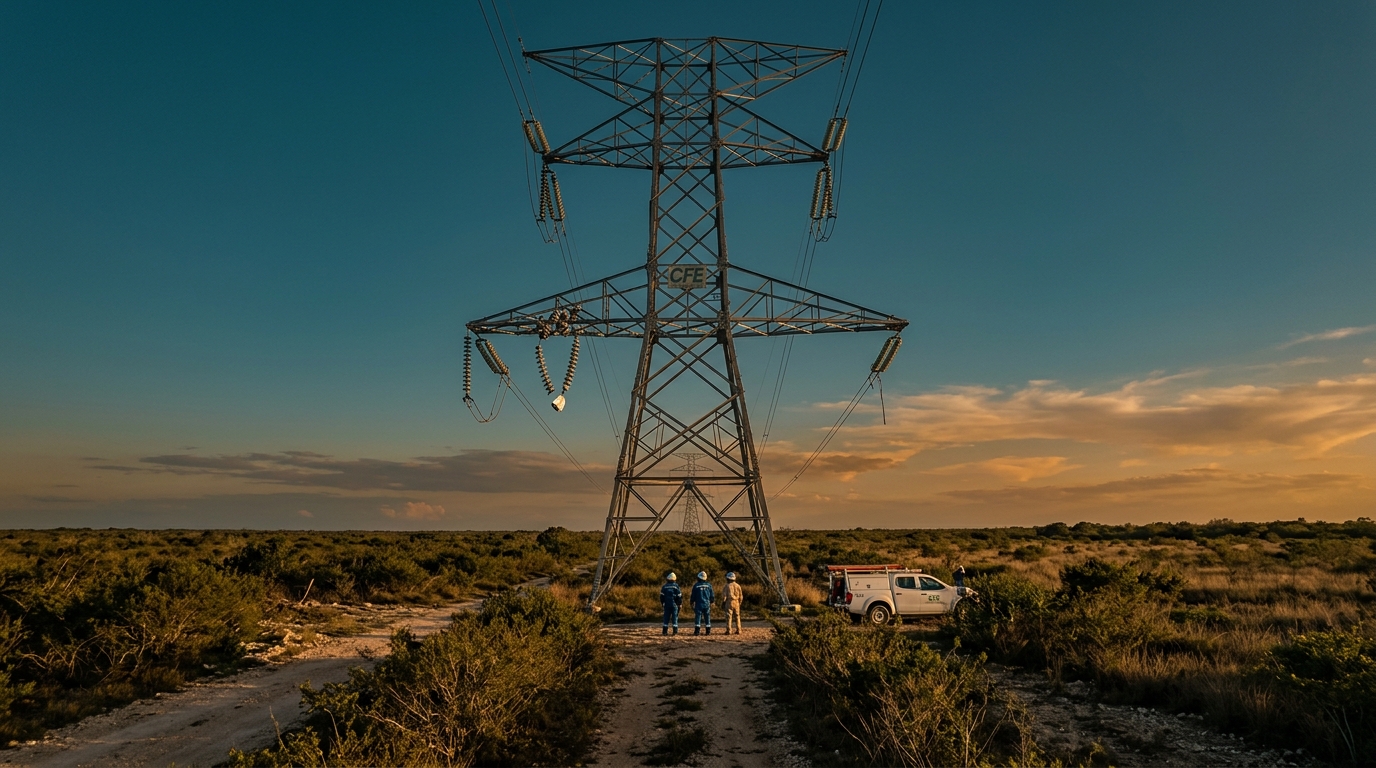
Vandalism targeting two 400-kilovolt (kV) high-voltage transmission lines cut electricity to Yucatan, Quintana Roo, Campeche, and Chiapas for approximately seven hours, from the night of August 31 through 3:00 a.m. on September 1, according to the Comisión Federal de Electricidad (CFE).
CFE attributed the shutdown of both lines to acts of vandalism and declared restoration work 100 percent complete in the early morning hours of September 1. The utility published images of the damaged infrastructure and reported that insulator replacement had been completed on one of the lines, with service restored to 55 percent of affected users, though it did not specify the number of customers, according to Bloomberg Línea. Hospitals in the region maintained power either through the grid or via emergency generators, and the Centro Nacional de Control de Energía (CENACE) coordinated the restoration operations.
The incident exposes the physical vulnerability of the 400 kV lines that supply the southeastern tourism and industrial corridor. Bloomberg Línea notes that Mexico's electricity system is prone to blackouts, particularly in the Yucatan Peninsula, due to insufficient infrastructure and network congestion in a corridor that is absorbing new demand from data centers and nearshoring-linked manufacturing. The failure comes days after CFE reported on August 18 that supply disruptions fell 37 percent between January and July compared to the same period in 2024, and that restoration times dropped from 25 to 7 hours, a 72 percent improvement. The company, led by Emilia Calleja, has committed to investing 8,500 million dollars to expand and modernize its networks by 2030.
CFE has yet to specify the number of customers affected by the outage. Execution of its 8,500 million dollar investment plan will determine whether the southeastern corridor can sustain supply against the region's growing demand.
This article was drafted with artificial intelligence assistance from verified sources and reviewed by a human editor before publication.
Sources
Related stories
This article was drafted with AI assistance from verified sources and reviewed by a human editor before publication.