Mexico's 14,000 MW Solar Push Faces a Skills and Storage Shortfall, Experts Warn
Industry representatives from solar and energy storage associations identify qualified personnel and battery capacity as the binding constraints on adding renewables to Mexico's National Electric System.
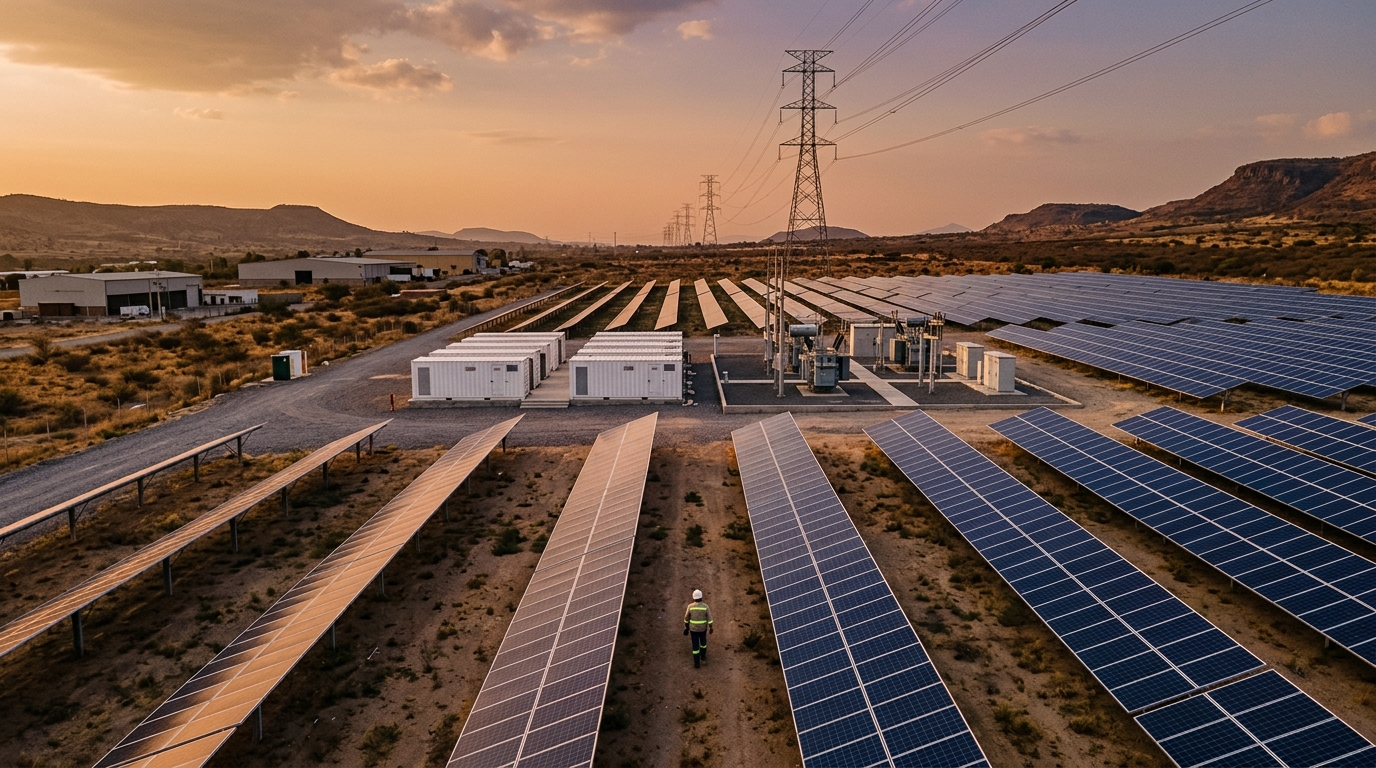
Representatives from the solar industry and energy storage associations warned on August 18, 2026, that a shortage of qualified technical personnel and limited battery storage capacity are emerging as two of the principal challenges to accelerating Mexico's energy transition, where solar capacity stands at approximately 14,000 megawatts (MW), according to Forbes México and Infobae.
The diagnosis comes as Mexico maintains more than 63% of its installed electricity capacity in fossil sources and roughly 32% in clean energy, according to 2023 data presented by Javier Tovar Facio, a researcher at the Universidad Autónoma de Chihuahua (UACH), at the 4th Summer Workshop on Process Systems Engineering at the Universidad Autónoma Metropolitana. Tovar Facio argued that this composition makes it necessary to plan plant retirements, battery siting, and transmission reinforcement through mathematical models, and warned that a grid lacking backup capacity and adequate transport raises the risk of outages.
Marco Antonio Guzmán, president of the Asociación Mexicana de la Industria Fotovoltaica, cautioned that the market has shifted from installing panels and inverters to integrating batteries and hybrid inverters, demanding a higher level of specialization. "We can have all the technology in the world, the money to invest, but if it isn't installed by qualified personnel, that project or that high-end equipment can be thrown in the trash due to poor installations," he said. Yolanda Villegas, president of the Asociación Mexicana de Almacenamiento de Electrificación y Movilidad, added that batteries have become strategic infrastructure and that storage reduces billing in the hotel sector by up to 40%. Gilberto Sánchez, president of the Asociación Nacional de Energía Solar, placed the primary bottleneck in distribution networks and unforeseen load consumption, given a capacity of over 93,000 MW against peak demand of around 57,000 MW.
More than 60% of Mexican industry's energy consumption corresponds to thermal needs, an area where solar thermal, with 5,000 MW installed, can substitute a portion of gas demand, Sánchez said. The critical issue to watch is the integration of storage and distribution networks into system planning, a conclusion shared by academic modelers and industry stakeholders alike.
This article was written with artificial intelligence assistance based on verified sources and reviewed by a human editor before publication.
Sources
Related stories
This article was drafted with AI assistance from verified sources and reviewed by a human editor before publication.
← All news