Iran Reports Container Ship Grounded in Strait of Hormuz, Chokepoint for 21% of Global Oil
A container ship runs aground in the Strait of Hormuz, reigniting the geopolitical risk premium on the waterway that carries 21% of global crude. Impact on Mexico's export blend.
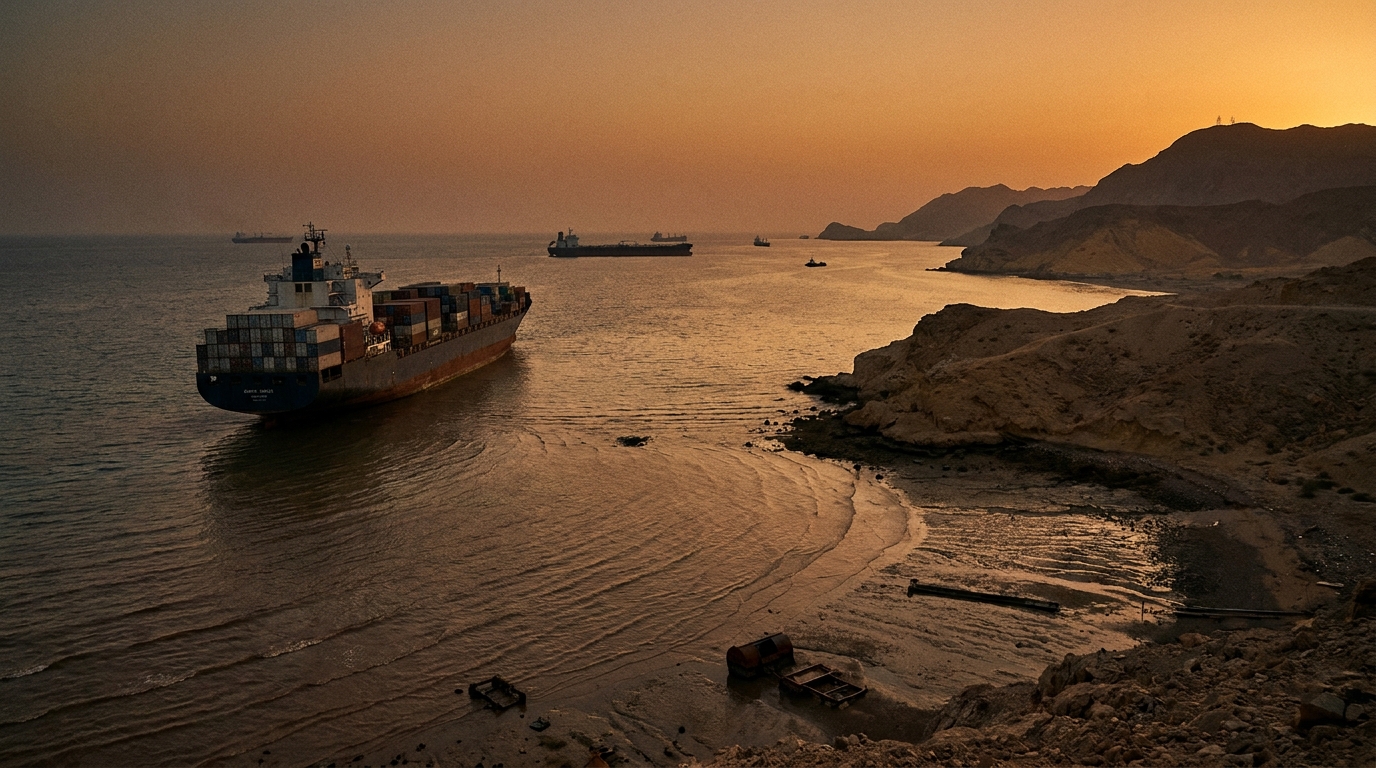
Iranian state television reported on July 1 that a foreign container ship ran aground in the Strait of Hormuz after navigating outside the shipping lane designated by Tehran. The incident on the waterway through which one-fifth of global oil transits has reignited the geopolitical risk premium on crude prices.
The Iranian Revolutionary Guard attributed the grounding to the vessel's decision to sail through shallow waters outside the corridor Tehran designates as the "Authority Route" in the Persian Gulf. The paramilitary force warned, as reported by Associated Press and confirmed by The Independent, that it has "repeatedly cautioned captains, shipowners, and officials" that transiting outside that route "could trigger irreparable incidents."
The Strait of Hormuz handles approximately 21 million barrels per day (mb/d) of crude and refined products, equivalent to 21% of global oil consumption, according to the EIA. For Mexico, the Mexican Export Mix (Mezcla Mexicana) is priced against the Brent benchmark, meaning any upward pressure on the North Sea reference grade flows directly into Mexican crude valuations and the cost of refined product imports from the U.S. Gulf.
Shipping traffic through the strait was already showing signs of disruption before the grounding. According to Kpler data cited by FXStreet, daily transits through Hormuz fell from 70 on June 24 to just 12 on June 28, amid the broader U.S.-Iran standoff over control of the waterway. WTI dropped to $69.40 per barrel on July 1, its lowest level in four months, though international benchmarks face upward pressure given the risk of a prolonged blockage.
The International Transport Workers' Federation (ITF) declared the Strait of Hormuz a war zone through at least July 9, driving up marine insurance rates and freight premiums on routes connecting the Persian Gulf with Latin American markets.
Any restriction on crude flows through Hormuz feeds immediately into the Brent differential and, through it, into the Mexican Export Mix price and the cost of gasoline and diesel that Mexico imports. The presence of U.S. envoys in Doha negotiating a resolution to the conflict will be the key variable to watch in the coming days.
This article was produced with artificial intelligence assistance from verified sources and reviewed by a human editor before publication.
Sources
Related stories
This article was drafted with AI assistance from verified sources and reviewed by a human editor before publication.
← All news