EIA: Costa Azul Triples Mexico's LNG Export Capacity, Adding 0.4 Bcf/d
Sempra Infrastructure's terminal in Ensenada is the first on Mexico's Pacific coast, opening a direct route for U.S. gas to Asian markets.
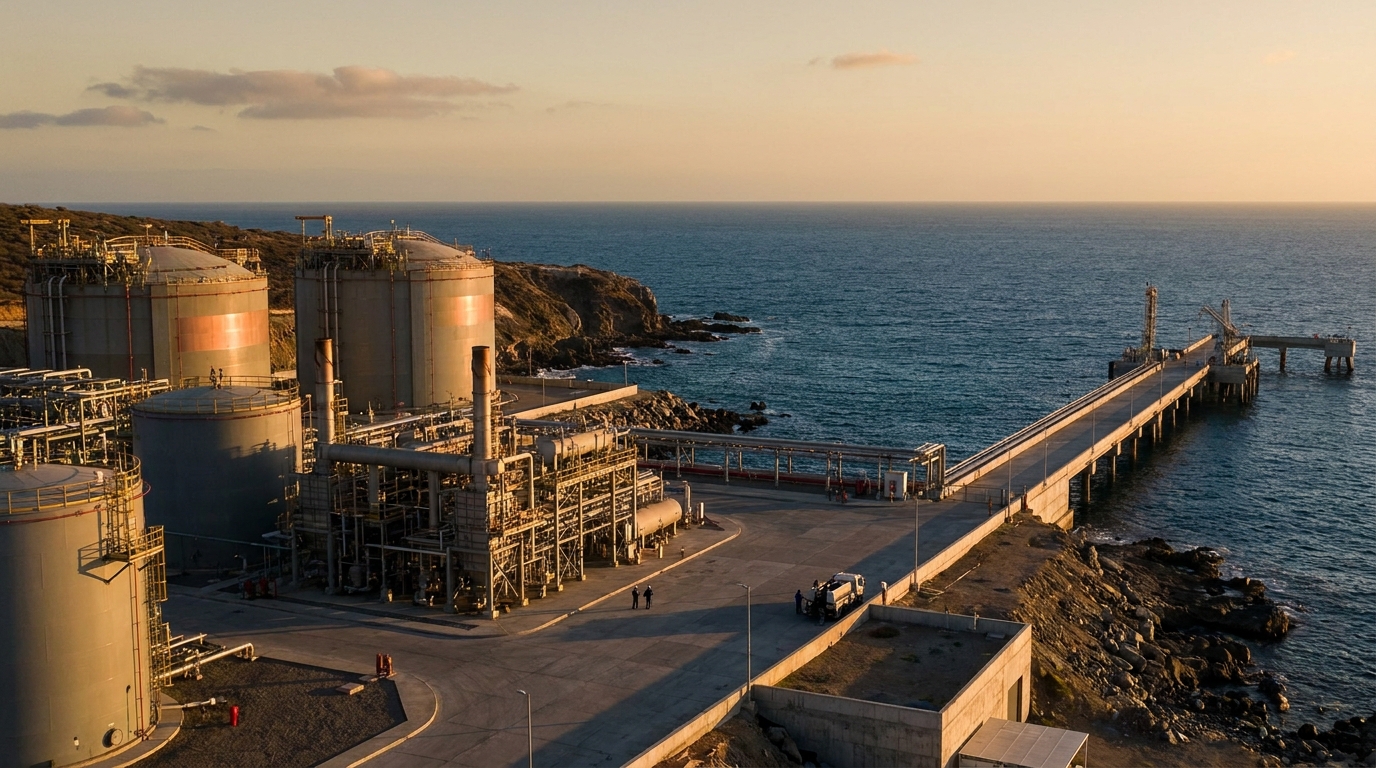
Sempra Infrastructure's Energía Costa Azul (ECA) terminal in Ensenada, Baja California, tripled Mexico's liquefied natural gas (LNG) export capacity by adding 0.4 billion cubic feet per day (Bcf/d) with the commissioning of Phase 1 in July 2026, according to the U.S. Energy Information Administration (EIA).
The first cargo departed on July 7, 2026, aboard the Pacific Success, operated by TotalEnergies, bound for South Korea, Bloomberg reported. ECA is the country's second LNG export terminal, after Altamira (New Fortress Energy, operational since 2024), but the first on Mexico's Pacific coast, enabling a direct route for U.S. gas to Asian markets without transiting the Panama Canal. The natural gas feeding the terminal originates from the Permian Basin in Texas and New Mexico, reaching Ensenada via the Rosarito Pipeline. Phase 1 consists of a single liquefaction train with a nameplate capacity of 3.25 million tonnes per year (Mt/yr), built at an investment of approximately $2 billion.
TotalEnergies holds a 16.6% equity stake in ECA and an offtake contract for 1.7 Mt/yr over 20 years as the sole offtaker during the startup phase, according to S&P Global Commodity Insights. Japanese trading house Mitsui secured an additional 0.8 Mt/yr under a long-term contract. To export LNG produced from U.S. gas, the project required authorization from the U.S. Department of Energy (DOE), which set a ceiling of 0.50 Bcf/d for free-trade-agreement countries and 0.44 Bcf/d for the rest, as detailed by the EIA.
With ECA's addition, total LNG export capacity on North America's Pacific coast reaches 2.2 Bcf/d. Sempra Infrastructure has a Phase 2 in its pipeline comprising two large-scale trains with an additional 1.6 Bcf/d (approximately 12 Mt/yr), pending a final investment decision. The terminal also retains its legacy import capacity: a cargo from Indonesia is scheduled to arrive on July 27.
This article was drafted with AI assistance from verified sources and reviewed by a human editor before publication.
Sources
Related stories
This article was drafted with AI assistance from verified sources and reviewed by a human editor before publication.