CFE Details Project Oasis: 72 MW Solar and 20 MW Green Hydrogen for Mulegé
CFE reveals the technical specifications of the Oasis project in Mulegé, BCS: 72 MW of solar capacity and 20 MW of green hydrogen to electrify an isolated grid currently dependent on diesel.
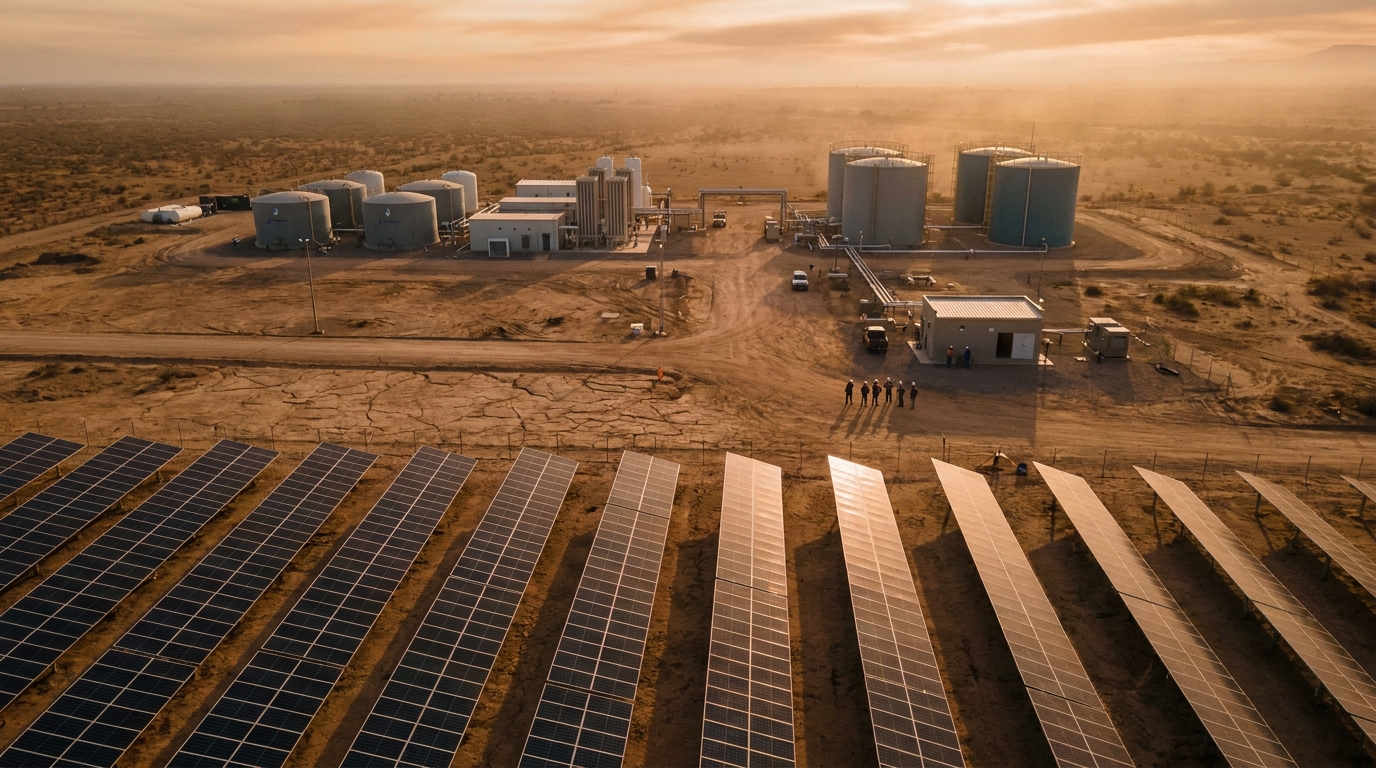
The Comisión Federal de Electricidad (CFE) released the engineering details of the Oasis project in Mulegé, Baja California Sur on July 3: a 72-megawatt (MW) solar plant, 20 MW of battery storage, 20 MW of electrolyzers, and 6 MW of hydrogen fuel cells, making it the first green hydrogen generation project operated by the state utility.
President Claudia Sheinbaum announced the project on June 24 as part of the national grid expansion strategy, but the technical data only became public this week. Mulegé operates as an isolated power system with no connection to the National Electric System (SEN). It currently relies on six low-capacity plants (two gas turbines, one internal combustion unit, one geothermal, one wind, and one solar) alongside diesel and fuel oil consumption, a combination that produces frequent blackouts. CFE Director General Emilia Calleja explained at the presentation that the project aims to harness the region's natural resources to strengthen its energy security. Sheinbaum described the project as zero-emissions and noted, per the official conference transcript, that very few countries in the world have projects of this kind.
The system operates in three stages: electricity from the solar panels powers the electrolyzers, which split water molecules into oxygen and hydrogen; the green hydrogen is stored and, when needed, converted back into electricity through fuel cells that feed into the local grid. According to CFE's figures, Oasis will supply the equivalent of 40,000 households, prevent 94,389 tonnes of CO₂ per year, and reduce fossil fuel consumption by 23,000 cubic meters annually of diesel and fuel oil. The system will also produce 120 cubic meters of water for the local population. Peak demand in Baja California Sur reached 680 MW in the week before the announcement, according to the National Energy Control Center (CENACE).
Israel Hurtado, president of the Mexican Association of Hydrogen and Energy Transformation, called the project a viable model for other isolated microgrids in the Gulf of California and Quintana Roo, where CFE is evaluating replication of the scheme. Oasis is the 28th hydrogen project identified in Mexico, but the first to be developed and operated directly by CFE.
This article was written with artificial intelligence assistance from verified sources and reviewed by a human editor before publication.
Sources
Related stories
This article was drafted with AI assistance from verified sources and reviewed by a human editor before publication.
← All news